Showing posts with label Panoramas. Show all posts
Tuesday, January 26, 2016
Too Much of a Good Thing
As I write this blog people in the mid-Atlantic states are digging out of a historic snowstorm. This time the predictions were amazingly accurate with almost a week's warning prior to this historic storm. At the start of the storm I was hopeful that we would get a nice snow, but not so much that I could not get out and make some images. By the time the weekend was over we had well over 2 feet of snow. Getting out to make images in the fresh snow was not an option this time.
So instead of getting out to make some images, I have been stuck behind the computer working on presentations, website updates, and of course doing some image processing.
The image above was shot 2 years ago in Maine. During that trip there was only about a foot of snow as I recall and getting around was pretty easy compared to the leftovers from the current storm.
Friday, December 18, 2015
Panoramas aren’t just for Landscapes
Panoramas are often an effective way to showcase the grandeur of a vast landscape. A photographer can often show more in a wide aspect panorama, instead of just stepping backward or using a wide angle lens. I love shooting panoramas in the great outdoors but I also find ways to use this technique on other types of photography as well. In the image above I shot 5 vertical frames of the lobby inside the former Women’s Auxiliary Building at the Trans-Allegheny Lunatic Asylum. I used a Nikon 14-24mm lens at 14mm on a full frame sensor. While that lens has a very wide field of view, it was not wide enough for me to capture the entire scene in one shot.
Back in the film days you would use a special camera such as the X-Pan. This was a camera that used 35mm film and would expose the image at 24mm x 65mm, instead of the traditional 24mm x35mm that is typical for 35mm cameras. Ten years ago I dreamed of owning an X-Pan, but the price of the bodies and lenses was prohibitive. Many used 35mm film cameras have become fairly inexpensive but if you look around a used X-Pan is not one of them. The only advantage I can think of today where a film camera such as an X-Pan would have the advantage over digital is with a fast moving subject. Slow moving subjects such as clouds and water work just fine for digital panoramas.
So if you want to start shooting panoramas with your digital camera you will need to learn a little about Parallax. Really Right Stuff has a great tutorial on their site. My panorama rig is from Really Right Stuff and while not inexpensive, in my opinion the quality is the best and worth the investment. There are less expensive options for a Nodal Slide and other assorted gear if cost is a factor.
Years ago I had two or three programs I used for assembling panoramas, because when one program failed to properly stitch the panorama, another program would often do the job. But in the last few years Photoshop has gotten so good at this feature I have not needed the other programs when I switched my processing from a PC to Mac. So today all my panoramas are assembled in Photoshop.
Some cameras (including my Fuji XT-1) will shoot handheld panoramas, but the results are not always precise and in the case of my Fuji, it saves the result as a Jpg file instead of a RAW file. I occasionally use the panorama feature on my Fuji, but when the shot really counts I use my tripod and panorama rig to get it right.
Monday, July 15, 2013
Palouse Day Five
On the afternoon of day five we took a 2 hour drive to
Palouse Falls. It is remarkable how much the landscape changes when you
leave farmland of the Palouse area.
What you cannot see are the wall to wall line of
photographers that were on both sides of me at sunset. Luckily I
had staked out my spot before the crowds arrived.
Thursday, August 26, 2010
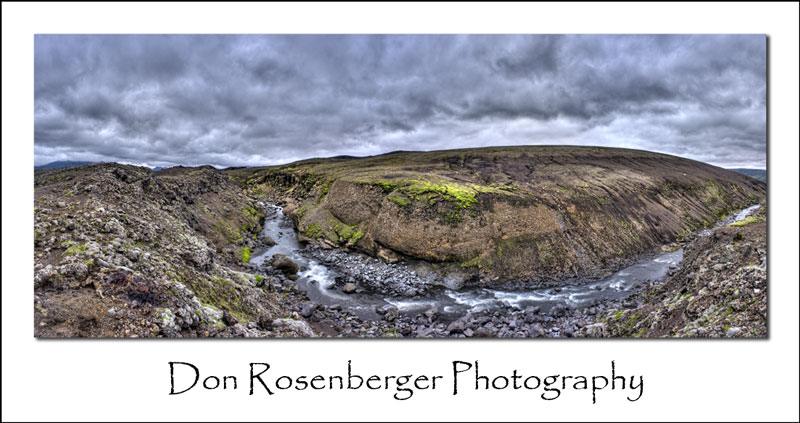
Icelandic Panoramas
I feel like I have been off the Blog for weeks. I have been busy working, shooting, and also editing pictures from Iceland. I hope to have a gallery up sometime soon. In the meantime, I wanted to post the above panorama and tell a little of the technical story behind the shot. For starters the stitched shot is 123 megapixels. The original tiff file is almost 800 megabytes. A couple years ago I purchased a used 28mm Perspective Control Lens. This is a manual lens, no auto anything. Nikon does not make this lens anymore and I was lucky enough to get a good deal on a used one. For shooting panoramas, a few things during the capture will lead to better results during stitching. I used a Pano Head and Nodal Plate from Really Right Stuff. I know some of the software programs are really good at stitching, but using this setup is worth the time and effort. The 28 PC lens allows you to adjust your perspective either up or down without moving the camera. If you level your camera when shooting panoramas you will often have a level horizon right through the middle of your shot. By adjusting the vertical perspective of the lens you have more latitude to compose your shot.
In the shot above I added another step. I adjusted the perspective down so I could see the bottom of the canyon, no sky was visible. I took the shot and then rotated the barrel of the lens 180 degrees and then took a shot that was mostly sky; moved the pano head about 15 degrees and repeated the process until I had covered the canyon end to end. This was my first attempt to create a double layer panorama. Usually I shoot my panos with the camera mounted vertically and then combine 8 or 9 shots to create the pano. In the scene above I was not able to capture the vertical range I was looking for without this technique.
The picture was taken on our second day in the field. We were traveling through an area known as the highlands in the southern part of the island. The picture below was taken a couple hours after the shot above. The terrain seemed to change around every corner. It was a magnificent day!!
Subscribe to:
Posts (Atom)